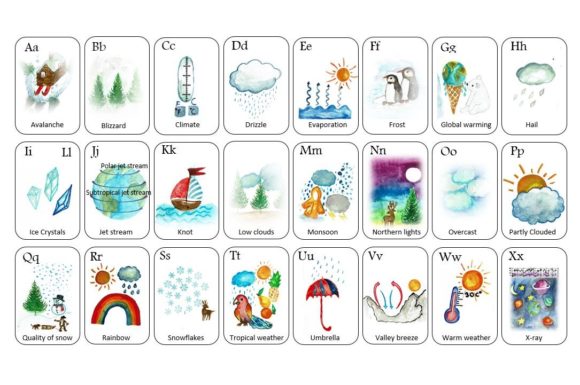
Weather A–Z Printable Alphabet Learning: A Versatile Tool for Modern Education and Creative Entrepreneurship
At first glance, a set of printable alphabet cards with a weather theme might appear to be a simple classroom accessory. Yet beneath that straightforward surface lies a resource that bridges early literacy, meteorological curiosity, and the growing demand for flexible, multi-use educational materials. Weather a-z printable alphabet learning combines the foundational skill of letter recognition with the universally engaging topic of weather, creating a tool that resonates across preschools, primary classrooms, Montessori environments, and even home-based creative businesses. In a landscape where educators and entrepreneurs alike seek materials that are adaptable, affordable, and visually compelling, this concept has quietly gained traction among professionals who understand the value of purposeful design.
What Is Weather A–Z Printable Alphabet Learning?
In essence, Weather a-z printable alphabet learning is a set of downloadable cards—each featuring a letter of the alphabet paired with a weather-related term or image. For example, “A” might stand for “Arctic air,” “B” for “Blizzard,” “C” for “Cumulus,” and so on. The cards are designed to be printed, cut, and used in a variety of educational and creative contexts. They serve as both an alphabet primer and an introduction to weather vocabulary, making them a crossover tool for literacy and science learning. Because they are printable, they offer unlimited reproduction, resizing, and customization—an advantage that traditional pre-printed classroom decor cannot match.
What sets this approach apart is its inherent flexibility. Educators can use the cards as wall art to create a print-rich environment, as flashcards for one-on-one instruction, or as part of a weather station display. Entrepreneurs and creators can repurpose the same digital file into products such as gift tags, bookmarks, or art prints. This dual function—educational and commercial—is precisely why Weather a-z printable alphabet learning has captured the attention of professionals working across multiple sectors.
The Intersection of Literacy, Meteorology, and Multisensory Learning
One of the most compelling reasons people are paying attention to this format is its alignment with contemporary understanding of how young children learn best. Research consistently supports multisensory, contextual approaches to early literacy. When a child sees the letter “R” next to an image of rain, they are not merely memorizing a symbol—they are building a web of associations that includes sound, image, concept, and real-world phenomenon. Weather a-z printable alphabet learning capitalizes on this by embedding letters within a thematic framework that children already find fascinating.
Weather is a universal conversation starter. Most children have experienced rain, sunshine, wind, and snow; they are naturally curious about why the sky changes and what clouds mean. By linking alphabet learning to this innate interest, the cards transform a routine drill into a meaningful exploration. Teachers report that weather-themed alphabet activities often generate more spontaneous discussion and vocabulary use than generic letter cards. This is not surprising—the context gives every letter a story, and stories drive retention.
From a developmental perspective, the weather theme also supports cross-curricular learning. A single card can prompt discussion about letter sounds, weather safety, seasonal change, measurement (temperature, wind speed), and even emotional vocabulary (“stormy feelings,” “sunny mood”). For special education settings, where concrete, sensory-rich materials are especially beneficial, these cards offer a visual anchor that can be paired with real objects (umbrellas, thermometers, rain boots) to create a fully immersive experience.
Why Entrepreneurs and Creators Are Paying Attention
The rise of printable educational resources has opened a significant market for creators who can design content that serves multiple purposes. Weather a-z printable alphabet learning fits neatly into this trend because it appeals to several distinct customer segments simultaneously. Homeschooling parents, Montessori educators, early childhood teachers, and even grandparents looking for thoughtful gifts all search for materials that are both educational and aesthetically pleasing. By offering a weather-themed alphabet set, creators can attract buyers who might otherwise overlook generic alphabet cards.
Entrepreneurs have recognized that the printable format allows for low-overhead product lines: no inventory, no shipping, and instant delivery. A single well-designed weather alphabet set can be repackaged as part of a larger weather unit study, bundled with matching coloring pages, or turned into a mini gift set for back-to-school season. The “back to school gift” use case is particularly strong—parents and teachers alike appreciate a meaningful, non-toy gift that supports learning. Pairing a set of printed cards with a small clipboard, a pack of crayons, or a weather journal creates a ready-made present that feels intentional and valuable.
For creative professionals, the design itself becomes a differentiator. The weather theme offers rich visual possibilities: soft blues and grays for rainy letters, warm yellows for sunny ones, dramatic contrasts for stormy terms. A cohesive aesthetic that works equally well on a classroom wall and in an Etsy listing is a powerful asset. Many successful creators now treat Weather a-z printable alphabet learning as a cornerstone product—one that can be adapted into different formats (posters, flashcards, mini books, bunting banners) while maintaining a recognizable brand identity.
Adapting to Evolving Educational Needs and Expectations
The educational landscape has shifted considerably in recent years, with a greater emphasis on flexibility, personalization, and teacher agency. Educators no longer expect one-size-fits-all curricula; they want resources they can adapt to their specific classroom composition, schedule, and philosophy. Weather a-z printable alphabet learning responds directly to this need. Because the files are digital, teachers can print only the letters they need, adjust the size for different uses, or select a subset that aligns with their current weather unit. This control is highly valued in settings where budget constraints and limited storage space make bulky pre-printed materials impractical.
In Montessori and Reggio Emilia environments, where child-led discovery and open-ended materials are central, the weather alphabet cards serve as a versatile provocational tool. A teacher might place a few cards on a tray alongside a magnifying glass, a thermometer, or a cloud chart, inviting children to make connections on their own terms. The cards are not prescriptive—they are starting points. This open-ended quality is a key reason why Montessori practitioners, who typically eschew commercial materials, have embraced printable alphabet sets with a thematic twist.
The shift toward hybrid and remote learning has also played a role. Families who supplement school instruction at home often seek resources that can be used offline, without screen time. Printable cards fill this gap perfectly. A parent can print a set, laminate it if desired, and use it for years. The Weather a-z printable alphabet learning format is especially suited to this context because it offers a tangible, hands-on experience that digital apps cannot replicate. In an age where parents are increasingly concerned about screen exposure, the appeal of a simple, physical learning tool is significant.
Practical Applications Across Diverse Settings
The versatility of these cards is best illustrated through the sheer range of uses educators and creators have developed. Here are several that demonstrate why this resource has become a staple for many professionals:
- Weather station companion: Mount the cards near a classroom window or a designated weather corner, and let children change the “letter of the day” to match current conditions. This creates a daily routine that reinforces both alphabet knowledge and observational skills. The cards become part of a larger weather station display that might include a thermometer, a rain gauge, and a chart for tracking weekly patterns.
- Memory game and puzzle activities: Print the set twice to create a simple memory matching game. Children can match letter to letter, or for a more advanced challenge, match the letter to the corresponding weather image. This extends the usable life of the cards and adds a social or independent play component that is valuable in both classrooms and home settings.
- Arts and crafts integration: Because the cards are printable, they can be used as templates for collage, painting, or tracing. A child might cut out the “T” for tornado and glue it onto a mixed-media storm scene, reinforcing letter shape through motor activity. For creators, offering a black-and-white version of the set opens up a coloring-book product line that appeals to parents seeking low-cost, reusable activities.
- Custom alphabet book creation: Print all 26 cards, punch holes, and bind them with a ring or ribbon to create a personalized weather alphabet book. This is an excellent project for children to assemble themselves, giving them ownership of the finished product. It also serves as a culminating activity for a weather unit—each child can illustrate their own version, making the learning deeply personal.
- Back-to-school gift and party favor: A small set of weather alphabet cards, wrapped with a ribbon and paired with a note about the weather theme, makes a thoughtful and memorable gift for classmates or students. Unlike candy or generic toys, this gift communicates a commitment to learning and creativity. For teachers, it doubles as a way to introduce the weather unit on the very first day.
- Wall art and classroom decor: Many educators print the cards on high-quality paper or cardstock and use them as a permanent alphabet wall display. The weather theme adds interest and conversation starters that generic alphabet strips lack. Some creators sell the digital files specifically formatted as posters (8.5x11 or 11x17) to meet this demand, expanding the product line without additional design work.
Each of these applications reflects a broader shift in how educational resources are consumed. The line between “curriculum” and “creative product” has blurred. A teacher might download a weather alphabet set on a Sunday evening, print it at home, laminate it at school, and have it on the wall by Monday morning. That speed and autonomy are not possible with traditional catalog orders. This immediacy is a major reason why the printable market has grown so rapidly in the education sector.
Connecting Weather ABC Cards to Broader Industry Shifts
Several larger trends converge to make Weather a-z printable alphabet learning a relevant product in 2025 and beyond. First, the mainstreaming of printable digital products has created a new category of “educational merch.” Teachers Pay Teachers, Etsy, and similar platforms have normalized the idea of buying a digital file and printing it at home. This has opened the door for creators who may not have a background in publishing but who understand design and early learning principles. The weather alphabet set is an ideal entry point because it is low-complexity yet high-appeal—a combination that experienced sellers recognize as a winning formula.
Second, there is a growing appreciation for interdisciplinary learning. Educators increasingly seek resources that connect literacy with science, art, and social studies. Weather is a natural hub for these connections. A child who learns the letter “C” for “cirrus” is also building a vocabulary word that will appear in later science lessons. This kind of embedding—where academic domains are not isolated but interwoven—reflects best practices in curriculum design. The weather alphabet card, though simple, exemplifies this interdisciplinary approach in a format that is immediately usable.
Third, the maker movement and the resurgence of hands-on, screen-free activities have created a receptive audience for printable materials. Parents and teachers who are disillusioned with passive digital consumption are actively seeking resources that require printing, cutting, and manipulating. The Weather a-z printable alphabet learning format satisfies this craving for tangibility. It is a product that asks the user to participate—to print, to organize, to display, to use. This participatory quality elevates it above passive content and aligns with the values of the modern maker-and-creator culture.
Finally, the economic environment has made cost-effective solutions more attractive than ever. Schools and families alike are watching budgets closely. A printable alphabet set, often priced between two and five dollars, provides a high perceived value relative to its cost. When that same set can be used for wall art, games, books, and gifts, the value multiplies. For creators, the low price point is offset by volume and the ability to sell the same design repeatedly with no inventory carrying costs. This is a business model that resonates deeply with the entrepreneurial audience—low risk, high flexibility, and a clear path to income.
Bringing It All Together: A Resource for a New Era of Learning
Weather a-z printable alphabet learning is far more than a set of flashcards. It is a reflection of how modern education, creative entrepreneurship, and consumer expectations have evolved. Educators want materials that are flexible, cross-curricular, and affordable. Parents want tools that are screen-free, engaging, and easy to implement. Creators want products that are simple to produce, visually appealing, and versatile enough to serve multiple markets. The weather alphabet card meets all of these criteria, and it does so in a way that feels fresh and relevant without being gimmicky.
For professionals looking to incorporate this resource into their work—whether as a teacher, a content creator, or a business owner—the key is to lean into its adaptability. Rather than treating Weather a-z printable alphabet learning as a single-use item, consider it a platform. From that one digital file, you can generate lesson plans, art projects, games, gifts, and decor. The more you explore its possibilities, the more value you will extract from it. And in a market where value is increasingly defined by versatility and intention, that is an advantage worth cultivating.