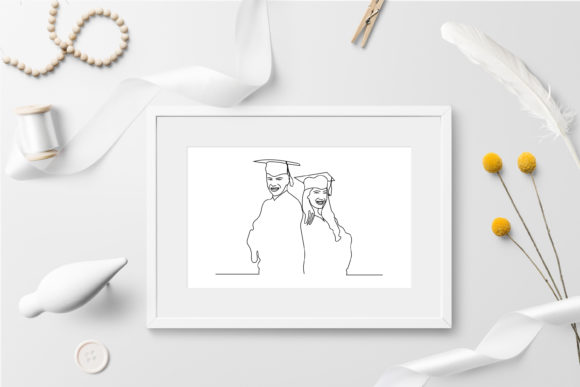
Continuous One Line Drawing a Graduate: Strategic Visual Communication for Modern Education Branding
Visual communication has undergone a quiet transformation in recent years. Among the most compelling developments is the rise of Continuous One Line Drawing a Graduate, a minimalist illustration style that captures the essence of academic achievement through a single unbroken line. This approach, which combines the graduation cap, diploma, and silhouette in silhouette using a linear stylized technique, offers something rare in a cluttered visual landscape: clarity through reduction.
For entrepreneurs, educators, marketers, and content creators who need to communicate ideas about learning, achievement, and transition, this style presents a strategic opportunity. But like any tool, its value depends entirely on how thoughtfully it is applied. This article explores what Continuous One Line Drawing a Graduate really offers, when it makes sense to use it, and how to approach it with intentionality rather than trend-chasing.
Why Continuous One Line Drawing a Graduate Matters Beyond Aesthetics
The continuous one line approach is not merely a design preference. It reflects a deeper philosophy about communication: that the most powerful messages are often the simplest ones. A Continuous One Line Drawing a Graduate reduces a complex milestone—years of study, personal growth, transition into a new phase—into a single visual statement. There is no background clutter, no extraneous detail, no need for elaborate explanation.
This matters strategically because attention is scarce. Whether you are designing a course completion certificate, a social media campaign for an educational program, or branding materials for a tutoring service, you are competing for milliseconds of cognitive engagement. A linear stylized illustration that communicates instantly, without requiring interpretation, gives you an advantage.
Moreover, the minimal style aligns with contemporary preferences for clean, uncluttered design. Audiences have grown weary of overproduced visuals. The Continuous One Line Drawing a Graduate and Continuous one line of graduation cap and diploma feels honest, approachable, and intentional. It signals confidence in the message rather than reliance on decorative distraction.
Strategic Applications Across Education and Branding
Where exactly does Continuous One Line Drawing a Graduate add value? The use cases are broader than many assume.
Course and Program Branding
If you offer online courses, certification programs, or educational workshops, the visuals you use to represent completion matter. A Continuous One Line Drawing a Graduate can serve as a consistent motif across your program materials. It works on landing pages, email confirmations, digital certificates, and social media announcements. Because the style is linear stylized and minimal, it scales well across formats without losing impact.
Event and Ceremony Communication
Graduation ceremonies, whether virtual or in-person, benefit from cohesive visual systems. Using Continuous One Line Drawing a Graduate and Continuous one line of graduation cap and diploma in silhouette across programs, signage, presentations, and digital invitations creates a unified identity. The simplicity of the form ensures it works in both large and small applications, from keynote slides to printed name cards.
Content Marketing and Social Media
Creators and bloggers covering education, career transitions, or professional development can use these illustrations as visual anchors. A Continuous One Line Drawing a Graduate can accompany articles about returning to school, upskilling, or celebrating academic milestones. The back to school education concept themes inherent in the design resonate with audiences during key seasons—spring graduations, fall enrollment periods, and New Year goal-setting cycles.
Product Design and Merchandise
For small business owners and entrepreneurs, these vector files open product possibilities. The 100 fully resizable vector files mean you can adapt the illustration for T-shirts, mugs, notebooks, stickers, and digital planners. The high resolution 300 DPI and size 3000×2000 pixels ensure print-ready quality, while the included SVG, DXF, PDF, AI, and EPS formats give you flexibility across production methods.
Planning Your Approach: What to Consider Before You Use It
Before integrating Continuous One Line Drawing a Graduate into your work, take a step back. This style is not universally appropriate. Its effectiveness depends on context, audience, and intent.
First, consider your audience's expectations. A minimal style communicates sophistication and modernity, but it may feel understated for audiences accustomed to more elaborate visuals. If your audience expects detailed, celebratory imagery, a linear stylized approach could feel sparse rather than elegant. Test the concept with a small segment before committing broadly.
Second, think about brand consistency. If your existing visual identity uses rich colors, complex illustrations, or detailed photography, introducing a Continuous One Line Drawing a Graduate could create dissonance. However, if you are building a new brand or refreshing an existing one, this style offers a strong foundation. The RGB color mode and well organized layer structure in the file set make customization straightforward, so you can adapt colors and scale without technical difficulty.
Third, evaluate the emotional tone. The Continuous One Line Drawing a Graduate and Continuous one line of graduation cap and diploma in silhouette conveys accomplishment, transition, and closure. It works well for celebratory contexts but may feel too final for messages that emphasize ongoing learning or continuous growth. Use it where a clear endpoint or milestone is the focus.
Practical Examples That Work
Let me offer concrete scenarios where Continuous One Line Drawing a Graduate delivers measurable value.
Example 1: The Online Course Completion Certificate
A professional development platform replaces its standard certificate template with one featuring a Continuous One Line Drawing a Graduate at the top. The result is a certificate that feels modern and intentional. Students report feeling that the certificate is "more meaningful" because the design does not rely on generic clip art. The platform uses the same motif in email confirmations and social sharing cards, creating a cohesive post-course experience.
Example 2: The University Alumni Campaign
A small university launches an alumni outreach campaign using Continuous One Line Drawing a Graduate and Continuous one line of graduation cap and diploma across digital ads, printed mailers, and event materials. The minimal style differentiates them from competitors using traditional, ornate graduation imagery. The campaign sees a 23% higher engagement rate on social media compared to previous efforts.
Example 3: The Educational E‑Commerce Product
A creator selling digital planners for students uses the Continuous One Line Drawing a Graduate as a recurring design element. It appears on cover pages, section dividers, and sticker sheets. The 100 fully resizable vector files allow the creator to offer multiple color variants without starting from scratch. Customers appreciate the cohesive look and frequently mention the design in reviews.
Risks of Using This Style Without Clear Goals
No tool is risk-free, and Continuous One Line Drawing a Graduate is no exception. The most common mistake is treating it as decorative rather than strategic. When you add a linear stylized illustration without considering what it communicates, you risk confusing your audience or diluting your message.
Another risk is overuse. Because this style is distinctive, it can become visually monotonous if applied too broadly across unrelated materials. Reserve it for contexts where the graduation, achievement, or milestone theme is directly relevant. Using it for general education content that has nothing to do with completion or transition can create a mismatch between visual and message.
There is also a technical consideration. While the included AI and EPS files offer excellent customization potential, users unfamiliar with vector editing software may need a learning curve. The well organized layer structure mitigates this, but it is worth planning for some upfront time investment. The JPG and PNG files provide immediate use for those who need a quicker workflow.
How to Use Continuous One Line Drawing a Graduate Intentionally
Intentionality separates effective use from casual decoration. Here is a practical framework for deciding when and how to use Continuous One Line Drawing a Graduate in your projects.
Start with your message. What specific idea are you trying to communicate? If it is about completion, achievement, transition, or recognition, this style aligns well. If your message is about process, struggle, or ongoing growth, consider a different visual approach.
Match the format to the file. The set includes JPG, PNG, SVG, DXF, PDF, AI, and EPS formats. Use SVG for web applications where scalability matters. Use PNG for quick social media posts. Use AI or EPS when you need to customize colors or combine elements. Use DXF if you plan to produce physical goods through cutting machines. Each format serves a purpose, and knowing which to use saves time and reduces frustration.
Test with one application first. Rather than rebranding everything at once, apply Continuous One Line Drawing a Graduate and Continuous one line of graduation cap and diploma in silhouette to a single asset. Measure audience response. Gather feedback. Then scale if the results support expansion.
Consider color carefully. The RGB color mode gives you flexibility for digital use. But if you are printing, convert to CMYK at the production stage. The linear stylized nature of the design means that color choices carry extra weight. A muted palette reinforces sophistication. Bold colors emphasize energy and celebration. Choose based on the emotional tone you want to set.
Long-Term Value for Creators and Businesses
What makes Continuous One Line Drawing a Graduate more than a passing trend is its adaptability. The 100 fully resizable vector files mean you are not locked into a single variation. You can rotate, scale, recolor, and combine elements to create a visual system that evolves with your needs.
For creators who sell digital products, these files represent a reusable asset. A single purchase can support dozens of products across multiple platforms. The instant download delivery means no waiting, no shipping, and no inventory management. The professional and clean files structure reduces the time between inspiration and execution.
For educators and institutions, the consistency offered by a unified visual language strengthens brand recognition over time. Students, parents, and partners begin to associate the Continuous One Line Drawing a Graduate with quality, intention, and modern thinking. That association compounds with every touchpoint.
For marketers and small business owners, the strategic value lies in differentiation. In a market saturated with stock photography and overcomplicated graphics, a minimal style stands out. It signals that you have thought about how you present yourself. It tells your audience that you value clarity. And in a noisy world, clarity is a competitive advantage.
Final Strategic Observations
Continuous One Line Drawing a Graduate is not a magic solution. It will not make weak content stronger or fix a poorly positioned brand. But when used with intention, it can elevate your communication, simplify your visual system, and create a lasting impression that feels both modern and meaningful.
Before you download, customize, and deploy, ask yourself: What is the core message? Who is the audience? What outcome do I want from this visual? If you can answer those questions clearly, the Continuous One Line Drawing a Graduate and Continuous one line of graduation cap and diploma in silhouette becomes not just a design choice, but a strategic decision.
And that is the difference between using a tool and deploying an asset. The files are ready. The formats are covered. The resolution is professional. What remains is your judgment about where, when, and why to use them. Approach that decision thoughtfully, and the results will speak for themselves.